Showing posts with label london. Show all posts

Tuesday, 7 November 2017

Crossrail 2: TfL has a plan B. Will it work?

Public news on Crossrail 2 is very limited, however it is slowly becoming clear that TfL has a plan to try and move the project forward. Whether it succeeds or not, depends on the Government.

Plan B

There was supposed to be a consultation on Crossrail 2 in late Autumn last year, 2016. It was stopped at the last minute, when the Government asked for more details on the business case.

So, TfL went away and produced a business case with the goal of funding half the cost of the project. But when the meeting with the Transport Secretary came in July 2017, it was clear that they hadn't entirely seen eye to eye.

What has become clear since is that TfL has now been asked to fund half the cost during construction. This is a much harder task, as TfL is already at maximum borrowing, and much of the money coming in for the next 15 years or so is allocated to paying off Crossrail 1.

One of the asks the government made of us was to pay for half the costs of Crossrail 2 in real time, so not simply paying it after the event, but paying during the course of construction. We think that's onerous and difficult, but we're trying to meet the needs of the government.
Sadiq Khan

The Crossrail 2 team needed a Plan B.

Based on various snippets of information, I believe that the Plan B involves splitting the project into at least 2 phases. Phase 1 would need to be quick to build and relatively cheap. Once phase 1 is open, money from farepayers starts flowing in, and that can be used to fund phase 2.

We've looked at the way you construct this, so what cash you have to spend at different stages of construction to ensure that you don't have to pay everything upfront for the whole scheme all at once. So what you do is you pay enough money to get certain sections of it delivered first of all, and then you pay some more further on.
Mike Brown, TfL commissioner

Other reports have mentioned a 10 year delay in Crossrail 2, which fits with this Plan B. ie. a 10 year delay to full completion of the project, not the opening of the first phase.

But what is Plan B?

The short answer is we don't know. However we can do some thought experiments.

Crossrail 2 as a whole is designed to tackle numerous problems (too many in fact, but that is a discussion for another day). Specifically it is intended to tackle overcrowding on the Northern line, Piccadilly line, Victoria line, overcrowding at Euston, and enable perhaps 80,000+ houses in the Lea Valley and 50,000+ south of Chessington. But meeting these goals makes the scheme expensive. For phase 1, the project has to be viewed entirely differently.

Phase 1 needs to deliver the highest farepayer revenue for the lowest cost in a short time period.

Enabling housing development is a good thing, but it tends to have a long payback period, as houses don't pop up overnight. Thus, our thought experiment suggests that house building would not be a big driver of phase 1, so no need to focus on either the Lea Valley or Chessington.

Whereas providing extra capacity at Euston by 2033 is repeatedly mentioned as being necessary. Thus, our thought experiment suggests that Euston is required in phase 1.

A lot of work has already been done at Tottenham Court Road as part of the Crossrail 1 project, and at Victoria as part of the upgrade there. Thus, our thought experiment suggests that the Euston - Tottenham Court Road - Victoria section will be part of phase 1.

Other leaks have suggested that Chelsea's station may be for the chop. Thus, our thought experiment should probably exclude that.

Now it gets interesting. Phase 1 cannot consist just of Euston - Tottenham Court Road - Victoria because two things are missing. There is no depot to maintain the trains and there is nowhere for the tunnelling machines to work from. Thus, phase 1 must extend either north of Euston or south of Victoria.

Heading north is cheap. All the cheap stations to build are in the north. But, many of the farepayers would currently be using the tube (Victoria or Piccadilly), so this wouldn't be new money for TfL. (Fewer passengers on the tube balanced by more passengers on Crossrail 2, thus not much genuine new money.)

Heading south is more expensive. Clapham Junction, Tooting Broadway and Wimbledon are all in the top 2 bands of cost. But, a lot of the fare revenue would be moving from the South West suburban to TfL. Another key aspect is that the depot was planned to be Weir Road, Wimbledon.

So, our thought experiment only gets us so far. Overall, I believe that phase 1 would need to include Clapham Junction to get revenue from the south. And just building Clapham Junction to Euston would be enough to get a decent amount of extra fare revenue.

Beyond the Clapham to Euston section, its pretty much total guesswork. I could make a case for these and many other routes: to Streatham Hill (surface) via Balham (underground), Wimbledon (surface) via Earlsfield (surface), Lea Valley via Tottenham Hale, the Shoreditch High Street development site (surface) via Angel (underground). We'll just have to see.

Summary

Crossrail 2, as planned, was too expensive for the Government, and it has basically told TfL to figure out a cheaper approach. TfL's plan B looks to be a two (or three) phase approach, getting fare revenue in as soon as possible to pay for phase 2. My thought experiment suggests Clapham Junction - Victoria - Tottenham Court Road - Euston will be in phase 1, but there needs to be something else to reach a depot and tunnelling site.

Thoughts welcome!

Thursday, 19 January 2017

Metropolitan Line Southern Extension?

The Transport Secretary, Chris Grayling, recently killed off the plan to allow the London Mayor to take over the Network Rail lines in South East London. This was despite a high benefit:cost ratio and broad agreement between all groups concerned earlier in 2016.

Given this, and the difficulty more generally of providing enough capacity in south London, this blog considers an alternative plan to provide additional capacity for South East London.

Metropolitan Line Southern Extension

South East London has a reasonable network of rail lines, and they reach two good central London terminals at Cannon Street and Charing Cross. But the time is fast approaching when that network is simply beyond capacity. Rather than look at Crossrail 3, or other super-expensive solutions requiring a new tunnel across Central London, it is time to consider extending the Metropolitan Line. Such an approach would complement the proposed Bakerloo Line extension to Lewisham.

Having looked at the options, an extension to Abbey Wood seems to make the most sense. In this scenario, the Elizabeth line (Crossrail 1) would extend to Dartford (or beyond) using the existing tracks:

The full route would be as follows:

  • Aldgate - rebuilt, interchange with District line
  • City Hall - new underground station
  • Bermondsey - underground interchange with Jubilee line
  • Surrey Quays - underground interchange with Overground
  • Deptford
  • Greenwich - interchange with DLR
  • Maze Hill
  • Westcombe Park
  • Charlton - interchange with service to Lewisham & Victoria
  • Woolwich Dockyard
  • Woolwich Arsenal - interchange with DLR
  • Plumstead
  • Abbey Wood - interchange with Elizabeth line (Crossrail 1)

For comparison, here is the existing map:

The first question to ask is whether it is possible to extend the Metropolitan Line at Aldgate, the current terminus.

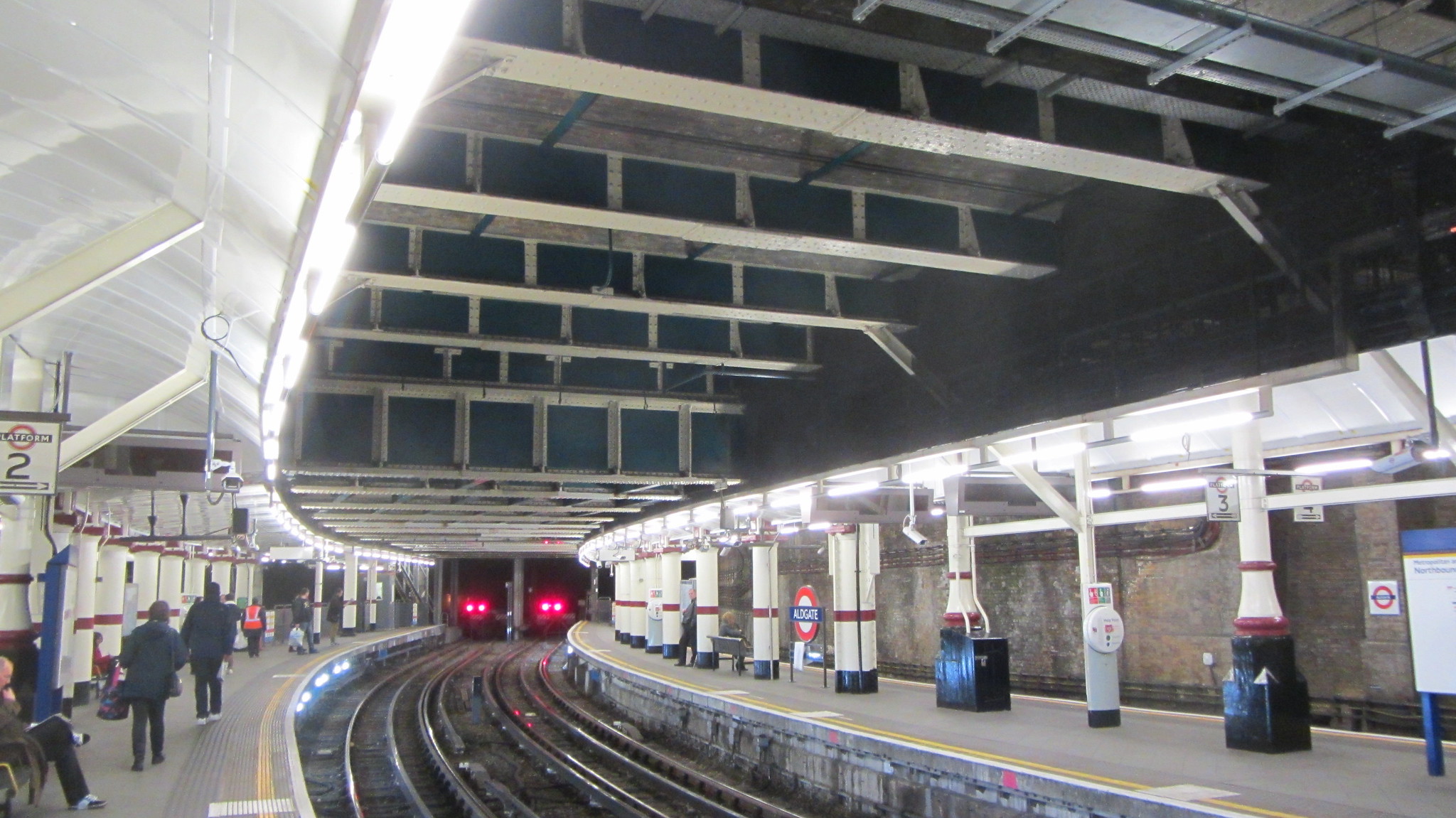
Given this is a site at the edge of the City, it is certainly tricky, but it seems that it should be feasible. Just south of the existing Aldgate station is a large bus station (behind the buffer stops in the second picture). The extension would use the bus station site to develop the new interchange station using standard top-down construction. To provide space, the Metropolitan line and Hammersmith & City line trains would have to terminate at Liverpool Street during the works, with the Circle line ceasing to run. The goal of the construction would be to build a four platform station - two platforms for the District line above two platforms for the Metropolitan line.

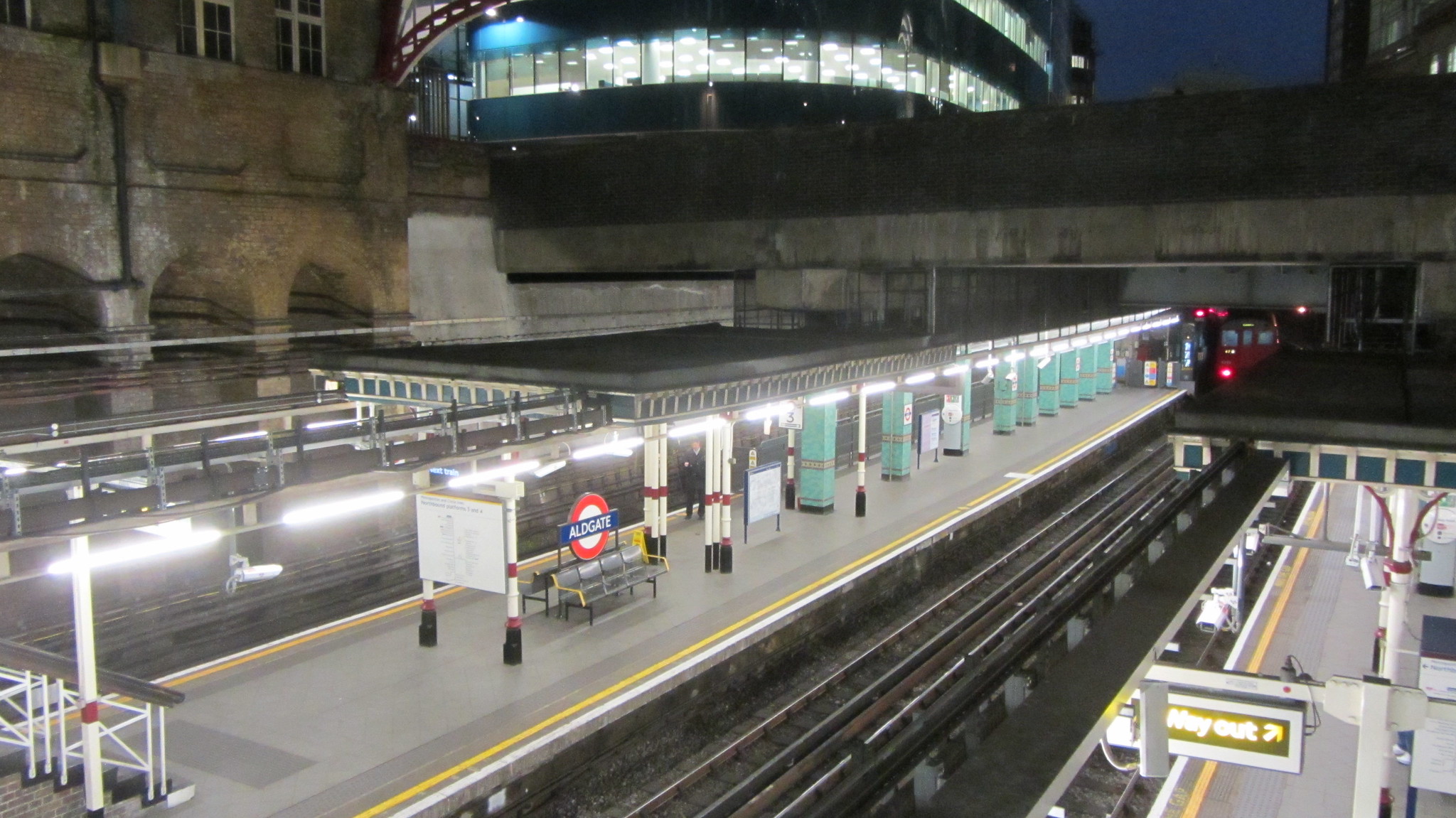
The Metropolitan line trains would need to descend from the current level to be beneath the District line. This would be achieved using the site of the existing Aldgate station (the first picture). Once complete, the tracks would be covered over, and the station turned into a bus station. The site of the new station (the existing bus station) would be developed.

Once complete and open, the service patterns of the existing lines would change radically. There would be no Circle line and no Hammersmith & City line. District line trains would all run from Earls Court through Victoria and Tower Hill to Whitechapel. Similarly, Metropolitan line trains from Hammersmith and Harrow would all run through Liverpool Street and on to Greenwich and Abbey Wood. In the west, a shuttle service would run from Edgeware Road to Gloucester Road in place of the existing Circle line. This service pattern eliminates most of the flat junctions from the District and Metropolitan lines, making services much more reliable and able to run at a higher frequency. Note that the loss of services from Liverpool Street to Whitechapel (the current Hammersmith & City line) is mitigated by the Elizabeth line, which runs on exactly that route.

Constructing the rest of the proposed extension is relatively easy by comparison with Aldgate station. It would involve two tunnel boring machines and three underground stations. The station at City Hall would be entirely new. The station at Bermondsey would be an underground interchange, designed for ease of use, while the station at Surrey Quays would require a rebuild of the Overground station as well.

The Bermondsey interchange is key to the success of the plan, because it provides passengers from the extended Metropolitan line a simple change to reach the West End. Journeys such as Greenwich to Bond Street become a pleasure, with one simple well-designed interchange. This is vital, as it greatly increases the time benefits to passengers, boosting the business case.

The final piece of the puzzle will be a tunnel portal location to access Deptford. One possibility would be to use the land of the New Cross branch of the Overground. Such an approach would allow more Overground services to run to Clapham Junction, Crystal Palace and/or West Croydon, but would also require the Metropolitan extension to have a short branch to New Cross.

Costs and Benefits

The benefits of this scheme are not limited to the line through Greenwich, because the scheme would free up paths into Cannon Street. (No services would run from Greenwich to Cannon Street - the line through Greenwich would be transferred from Network Rail to TfL.) Currently, there are 7 trains per hour from Greenwich to Cannon Street between 7am and 9am. These paths would be reallocated to other services, benefiting passengers on other lines, including the routes to Sevenoaks, Hayes, Bexleyheath and Sidcup.

Passengers currently using services from Greenwich would still have direct trains to the City, but would have a choice of Aldgate, Liverpool Street and Moorgate instead of Cannon Street. Passengers for London Bridge would get off at City Hall, while passengers for the West End would change at Bermondsey. As such, existing passengers would not see major changes to their journeys causing disbenefits.

Costs are always hard to estimate, but a rough guess can be based on 5km of tunnelling, four underground stations and line conversion works on takeover from Network Rail. Say £500m for the tunnels, £1bn for Aldgate, £2bn shared between the other three underground stations, and £1.5bn of other work, suggests a possible total of £5bn. This compares with £3bn for the Bakerloo line extension, so the cost estimate seems sound enough.

The cost of extending the Elizabeth line to Dartford would need separate examination. I'd note that initially, the Metropolitan line extension could run to Charlton, rather than Abbey Wood to side-step that problem.

Summary

This is a proposal to extend the Metropolitan line from Aldgate to South East London, taking over the line from Deptford to Abbey Wood via Greenwich and Charlton. It provides a step change in service to that line, a radically simpler and more reliable service on the District line, and an additional 7 peak-hour paths into Cannon Street for the rest of South East London and Kent. And all for around £5bn.

Given that there won't be a TfL run South Eastern Overground any time soon, a plan like this may well be the best way to improve rail services in this part of London. Thoughts welcome!

Friday, 4 November 2016

South London rail devolution

TfL recently published a new document on south London rail devolution in response to a Government request. This blog examines what it says for South East and South Central London.

Rail devolution in south london

The new document provides a narrative and formal business case for devolution from the Department for Transport (DfT) to Transport for London (TfL). The headline benefit/cost ratio (BCR) is 4.3 : 1, which is high value for money, and difficult for DfT to argue with, however devolution is by no means certain, with the new Transport Secretary being more cautious on the topic than his predecessor.

The document focuses on a number of themes. It makes the case that long distance travelers will not lose out, something that will be key in making the plan happen. It argues that there is considerable scope for additional housing, currently held back through poor rail services. Fiscal neutrality is claimed, so the Treasury is no worse off. And wide stakeholder support is identifier, with many supporting letters.

All in all, considering TfL and the Mayor had just three and a half weeks to pull it together, it is pretty impressive. The most interesting part however is appendix 5, where the concept of "metro-isation" is examined.

Metro-isation of rail in south London

Due to history, the tube does not extend far into south London. This results in pressure on mainline rail, with an extensive network of tracks and stations. However, while the network is relatively dense, it is also tangled. Service patterns are complex and low frequency, often only two trains per hour 2tph. The key question is what would it take to increase frequencies to 6tph on most lines?

TfL identifies six points that need to be addressed:

  • Predictable services
  • Better connections
  • More capacity
  • Shorter journey times
  • Reliability
  • Better customer service

For details of each of these, see appendix 5 of the document.

The most interesting parts are where the current and potential service patterns are shown. These are of course speculative by TfL, requiring investment in new trains, signalling and turnbacks, but they give a good idea of the plan TfL has in mind. This is the concept for South Central London:

Click the diagram to enlarge it, and click here for the current service pattern.

The most significant would be an enhanced station at Streatham Common, with new platforms on the high-level tracks from Streatham to Sutton. This would provide the key interchange necessary to allow people to move across south London. Additional turnbacks would be needed at Belmont (for a healthcare campus), Wallington, Cheam and West Croydon, with two additional platforms likely at East Croydon through other planned work (a turnback is a location where trains can terminate and head back the way they came from).

This provides a summary of the key services:

  • Balham to Victoria - from 14tph today to 18tph
  • Streatham and Tulse Hill to Blackfriars - from 4tph today to 8tph
  • Tulse Hill to London Bridge - stays at 8tph
  • Crystal Palace, Gipsy Hill, West Norwood and Streatham Hill to Victoria - from 4tph today to 6tph
  • Crystal Palace, Gipsy Hill and West Norwood to London Bridge - from 2tph today to 4tph
  • Selhurst, Thornton Heath, Norbury and Streatham Common to Victoria - from 6tph today to 8tph
  • Selhurst, Thornton Heath, Norbury and Streatham Common to London Bridge - from 2tph today to none
  • Sutton to Streatham and Tulse Hill - from 4tph today to 8tph
  • London Overground, from 4tph today to 6tph on each of the three routes in South Central
  • Leatherhead and Epsom semi-fast services - unaffected

The key trade-off is the loss of direct services from Selhurst, Thornton Heath, Norbury and Streatham Common to London Bridge. Passengers get a more frequent service to Clapham Junction and Victoria instead, with the new Streatham Common interchange allowing passengers to change to reach London Bridge and Blackfriars.

Is it feasible? For the most part, it should be with new trains and signalling. However, Herne Hill will certainly be tight, with 8tph of Thameslink services crossing 13tph of South Eastern services on the flat. There will also be some slightly awkward timetables where 6tph services and 4tph services share the same tracks. In this respect, the 6tph frequency on the Crystal Palace and Streatham Hill to Victoria route looks odd, when 8tph would be easier to timetable.

In South East London, this is the concept:

Click the diagram to enlarge it, and click here for the current service pattern.

Again, there would need to be investment - extra tracks around Penge East to allow fast trains to overtake slower ones, Cannon Street, Lewisham and Dartford enhancements, plus better signalling.

The service pattern is not as neat as South Central in places, but that is probably because it has been developed more. It does provide a solid 6tph to the Greenwich, Bexleyheath and Sidcup lines. From Victoria to Orpington via Herne Hill would move to 6tph, and also 6tph Victoria to Lewisham via Peckham Rye.

Is it feasible? Well Cannon Street certainly sees a big increase in services, but far from impossible with the right investment. And off-peak it shows no trains from Sidcup to Dartford, which would need fixing. However, it looks like a fairly solid plan off-peak, and harder to judge in peak.

Summary

The document shows TfL are still pushing hard for rail devolution for South East and South Central London, and for good reason - there is the potential to make a big difference in service, driving growth and housing. The specific concept frequency maps are interesting, but obviously only outline at this point. Nevertheless, were they to come to pass, they would be a major improvement on current services.

Thursday, 24 March 2016

Crossrail 2 and Merton

Crossrail 2 continues to progress. The National Infrastructure Commission has backed it. And the chancellor has provided money for the next stage of planning. The next few months will be key for how Wimbledon and Merton will be impacted over the next 20 years.

Crossrail 2 and Merton

Crossrail 2 is coming to Merton and that potentially means big changes for Wimbledon, Raynes Park and Motspur Park. While it may be tempting to try and stop the scheme, the passage of the HS2 third reading yesterday in parliament indicates clearly how ineffective the "stop HS2" campaign has been. Given this, I argue that it would be wise for Merton residents concerned about Crossrail 2 to fight for improvements to the project, rather than trying to stop it altogether.

Sadly, the Crossrail 2 team only put forward one option at consultation. However there are four basic approaches which could be adopted at Wimbledon. This table summarises the impacts of each option:

Option Option 1:
Demolish to the south
Option 2:
Demolish to the north
Option 3:
Deep tunnel platforms
Option 4:
Fast line tunnel
Total amount of demolition in Wimbledon town centre Major Major Some None
Demolish Centre Court shopping centre Yes No No No
Rebuild entrance to Wimbledon station Yes Yes Yes Yes
Trams move up to street level, platform 10 destroyed Yes No No No
Tunnel portal site Gap Road Gap Road, or perhaps Waitrose Demolish 150 houses in Raynes Park, or needs two tunnel portals Wasteland at Berrylands & Weir Road industrial area
Turn-back & dive-under in Dundonald area Yes Yes No No
Widen from 4 to 6 tracks between Wimbledon and Raynes Park Yes Yes Partial No
Impact on Raynes Park station rebuild Major rebuild Major rebuild Major rebuild Smaller rebuild
Cost Baseline Assumed to be similar to basline £2bn+ more expensive In theory, should to be cheaper
Is it viable given what is currently known? Yes Yes No Yes

The four basic approaches to get Crossrail 2 through Wimbledon are:

Option 1: "Demolish to the south" - This is the current official plan, where Centre Court, the Prince of Wales and many other buildings are demolished to build new sub-surface platforms (just 10m underground).

Option 2: "Demolish to the north" - A similar approach to the current official plan, but demolishing the north side of the station instead (the taxi rank, HSBC, magistrate courts etc). Again the new platforms would be sub-surface (just 10m underground).

Option 3: "Deep tunnel platforms" - This would involve constructing two or four deep platforms (perhaps 30m underground), similar to Crossrail stations in central London. The Crossrail 2 team estimate this would cost £2bn more, and potentially involves demolition of 150 residential properties in Raynes Park. It would also require significant demolition in Wimbledon town centre for the lift and escalator shafts to the deep platforms. Since I have seen no evidence of a viable way to build this option without ridiculous residential demolition impacts, I've marked it as not viable in the table.

Option 4: "Fast line tunnel" - This involves a new tunnel from Berrylands to the Earlsfield area, taking the trains on the current fast lines. This frees up two tracks and two platforms at Wimbledon, providing the space for Crossrail 2 without major demolition. This is also known as the Swirl plan. (Note that a fast line tunnel for Merton is viable with whichever station is chosen for Wandsworth - Balham, Tooting or Earlsfield. Note also that the table describes a minimal fast line tunnel option where either all 30tph run through to the branches, or 10tph turn-back at Clapham Junction.)

A key point arising from the table is that option 2 is very similar to option 1. Both involve major demolition in the town centre, turn-backs, dive-under and widening to 6 tracks.

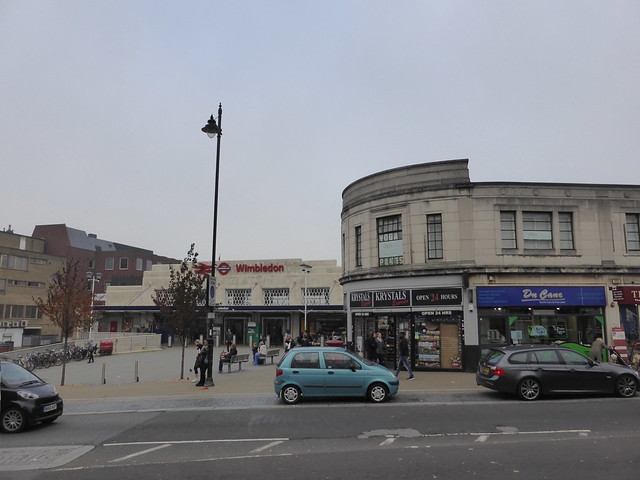
Wimbledon, London

As a little bit more detail, these bullet points outline the work involved for option 1 in Merton (the official plan). This is intended to help explain the rows in the table above:

  • Four new sub-surface platforms at Wimbledon station, created by demolishing much of the Centre Court shopping centre and many other buildings in the town centre
  • The loss of platform 10 from the existing Wimbledon station, permanently restricting the frequency of Thameslink services
  • Trams moving out of the station up to street level
  • A tunnel portal at the Gap Road worksite, where the main tunnel is dug from
  • A new road bridge between Queens Road and Alexandra Road
  • A turn-back facility at the Dundonald Road worksite, to allow trains to reverse
  • A dive-under at the Dundonald Road worksite, for Northbound trains to reach the new platforms
  • Two additional tracks between Wimbledon and Raynes Park (6 tracks instead of the current 4 tracks)
  • Major rebuild of Raynes Park station for cross-platform interchange and access for all, likely to involve land take north of the current station site

The construction period is likely to be around 10 years, plus subsequent work to redevelop the worksites. There are also likely to be many resulting lorry movements.

Summary

When the four options for Wimbledon town centre are evaluated side by side, it is clear that only a fast line tunnel will really improve the Crossrail 2 scheme for Merton. The key benefit is that it removes all town centre demolition apart from reconstructing the station itself. However the benefits go beyond that, avoiding the need to widen to six tracks between Wimbledon and Raynes Park, require no turn-backs or dive-under in the Dundonald area, and reducing the land take needed by the rebuild of Raynes Park station.

Hopefully the table above helps clarify why this blog is arguing that a fast line tunnel is the only option Merton residents should be arguing for (via your residents association and elected representatives).

Sunday, 13 March 2016

Crossrail 2 and the National Infrastructure Commission

The National Infrastructure Commission provides an independent high-level view of significant infrastructure projects. It is led by Lord Adonis and has recently published a report on transport in London.

Transport for a World City

The Commission published two reports on the same day. The first is the commission's opinion. The second is an independent report drawn up by consultants. This section examines the commission's report.

The commission report is relatively simple.

The Commission concludes that the strategic case for Crossrail 2 is well founded and recommends that it is taken forward. It is not a substitute for smaller scale improvements, but these alone will not be enough.

Later it adds:

The case for Crossrail 2 is that it will:
* Provide vital relief for the congested southern end of the Northern Line and for the Victoria Line through north-east and central London. These are forecast to see much of the highest levels of crowding anywhere on the Underground, after the opening of Crossrail 1.
* Provide an alternative route, via its connection to Crossrail 1, from southwest London to the City and Canary Wharf, reducing passenger numbers on the overcrowded Waterloo and City line and the eastern part of the Jubilee Line.
* Relieve capacity constraints on the critically over-crowded south-west London commuter lines coming into the capital through Wimbledon, Clapham Junction and Waterloo by providing an alternative route for inner suburban services via a new tunnel from Wimbledon into Central London.
* Reduce terminal congestion at the UK’s busiest station, Waterloo, as well as cutting crowding levels at Clapham Junction, Vauxhall and Wimbledon, all of which are forecast to face insuperable operational difficulties due to the volume of passengers at peak hours.
* Release capacity on the existing south-west network for longer distance services from Basingstoke, Woking, Guildford, Southampton and beyond.
* Provide four tracks on the West Anglia Mainline to enable faster services on the London-Stansted-Cambridge Corridor.
* Link with Euston/St Pancras, to provide onwards dispersal for those arriving into London from the north on HS2, which is planned to be completed to Manchester and Leeds in 2033.
* Stimulate new housing, jobs and development along the whole route. In particular the line will transform access to the Upper Lee Valley Opportunity Area – one of the largest in London.
* Establish a turn-up-and-go level of service at a range of underserved destinations allowing for regeneration around transport hubs in Hackney, Haringey, Enfield and Tottenham.
* Unlock 200,000 homes, provided the right planning framework is applied.

It is interesting to note that the first item is relief of the southern section of the Northern line (not the Victoria, Jubilee or Piccadilly). Regular readers known my scepticism of this claimed relief.

Finally, there is this key section:

The costs of Crossrail 2 are high and therefore every opportunity should be taken to improve its affordability.
* The updated case should include detailed options to reduce and phase the costs of the scheme. The most promising option identified to enhance affordability would be to delay the construction of the northwestern branch to New Southgate. This could reduce the costs of the initial scheme in the 2020s by around £4 billion. More work should also be done on the costs and benefits of individual central London stations.
* If construction of the north-western branch is delayed, this would also provide the opportunity to consider the case for an eastern branch from Hackney as an alternative.

On cost savings, the following possibilities are mentioned:

  • Dropping the Chelsea station
  • Balham, not Tooting
  • Work on the station design and approaches to Wimbledon
  • Wood Green, not Turnpike Lane and Alexandra Palace
  • Dropping or delaying the New Southgate branch

All in all, there is nothing particularly surprising about the commission's report. It says lots about finance, housing and growth. And on Crossrail 2 itself, it backs the official scheme almost in entirety, the main exception being the possible dropping of the New Southgate branch.

Review of the Case for Large Scale Transport Investment in London

The second report is from independent consultants. It is much more interesting in the ideas presented, however it cannot be seen as the commission's opinion. Nevertheless, it is worth summarising some of the key ideas mentioned in the report.

In the North, the second report also discusses dropping the New Southgate branch. (This may be where the commission got the idea.) However, dropping the branch is not discussed in isolation. Instead, the report proposes investigation into a "cost effective cross-London route" from Moorgate to Waterloo. The map shows the proposal in red, with the dropped Crossrail 2 branch to new Southgate in dashed blue.

The proposal is to take the existing National Rail services from Hatfield, Welwyn and Hertford to Moorgate through a new tunnel to Waterloo and beyond. Potentially this may need only two new underground stations - Cannon Street and Waterloo - although it is more realistic to also expect Moorgate may require a rebuild. Beyond Waterloo, the proposal is to take the line to the Battersea area, and beyond.

This is a sensible proposal, very similar to Swanlink. Construction would however probably require some lengthy closures of the line from Finsbury Park to Moorgate. It is likely to be relatively cheap, with minimal tunnelling and few new stations.

In zone 1, the second report enthuses about an extension of the DLR from Bank to Euston/Kings Cross, with closure of Tower Gateway. Such a scheme would be well used, but whether it is the best option is a different question.

In the east, there is discussion of a north-south line from Stratford to Lewisham via Canary Wharf. This is similar to the Sussex relief line proposal. There is little detail however - it is little more than a couple of sentences.

In the South, the second report outlines a whole range of thoughts under the heading "Potential refinements to Crossrail 2". The section begins by talking about cost savings, where it suggests surfacing the tunnel between Clapham Junction and Earlsfield, noting that this does not provide any Northern line relief. Again, it hints at removing Chelsea without being explicit. These two changes are shown here:

The next section discusses phasing, including the rather impractical suggestion of only building Victoria to Euston.

In another section, thoughts turn to changing the specification of Crossrail 2 to an automated metro with dedicated access to tracks. This would require there to be no services from the southern branches to Waterloo. Undoubtedly, this would simplify operation, and raise the potential of 40tph (perhaps of shorter trains). However, it seems that it would be tricky to get the segregation necessary.

The report then discusses increasing the scheme benefits. Here the report argues that Crossrail 2 leaves Earlsfield "stranded", and that a branch to Balham and Streatham would makes sense. This is essentially the argument I made in the Swirl-Max plan. In an ideal world, I remain convinced that Swirl-Max servces southern Wandsworth better than the official plan, with an expectation of more Northern and Victoria line relief. If money is tight, then Swirl remains the better option.

Finally, the report suggests a link from Motspur Park to New Malden, shown in red on the map above. This link, potentially funded separately from Crossrail 2, would allow through services from Epsom and Chessington to Kingston and Twickenham. This would effectively be orbital, rather than radial travel. This seems very sensible, and potentially allows the frequency on the Epsom and Chessington branches to reach a more sensible 8tph rather than the currently proposed 4tph.

Summary

It is easy to get carried away when reading the second report, as there are lots of potentially great ideas in there. However, it is only the report of consultants, not the report of the commission itself. And the commission's report is very bland, backing the existing plan almost in its entirety, Although it does look like the New Southgate branch is for the chop.

That said, it is great to see a tunnel south from Moorgate, and routing Crossrail 2 via Earlsfield with a branch to Streatham in a key document. While it may come to nothing, it is at least a marker for the future.

Finally, it is clear that residents in Merton looking to reduce the impact on Wimbledon and Raynes Park need to continue arguing for a "fast line tunnel", as it is still the only option that will make a significant difference. And residents in the London/Surrey borders should continue to argue for a routing via Earlsfield to avoid their services being slowed unnecessarily.

Friday, 15 January 2016

Orange South London

The think tank Centre for London published a report on rail in South London today (14th January 2016), entitled "Turning South London Orange". This is my thoughts on the report.

South London

The report outlines the problems facing rail in South London (specifically South Central, not South East or South West) and proposes some solutions. It tackles these in the context of London Overground, the "Orange" network of tube maps. As well as covering the transport side, the report adds background and numbers on the project growth and potential additional growth that could be unlocked by an investment. It recommends TfL (Transport for London) takes over the existing services within London (ie. conversion to London Overground), and it gives consideration to a new regional transport body covering London, Kent, Surrey and Sussex to balance the needs of London with those beyond.

The rest of the article will focus mainly on the proposed investment ideas. Firstly, there is a set of ideas that few would disagree with:

  • Enhanced signalling, with greater automation
  • Better trains, with wider doors, better braking and acceleration
  • More effective station stops, using staff and technology
  • More turnbacks, to provide for a high frequency service

Beyond the basics, three more specific investment ideas are discussed, starting on page 44.

A new South London Line

This proposal is to increase the frequency of the line from Victoria to Lewisham and provide more stations.

The current Overground service runs from Clapham Junction to Canada Water and beyond at 4tph (trains per hour). The report propose increasing this to 6tph, and adding an additional Victoria to Lewisham service, also at 6tph. To make this work, the report suggests additional platforms at Battersea (near the power station), Wandsworth Road, Clapham High Street, Clapham East, Brixton and Brockley.

Thameslink, Herne Hill, and a resolution for Brixton

This proposal is for a new tunnel running from the Wandsworth Road area to the Dulwich area. This would be a fast line tunnel, taking those services from Kent that run non-stop from Bromley South to Victoria.

By building a new fast line tunnel, the flat junctions at Herne Hill and Brixton are relieved. This would provide enough space for the proposed Victoria to Lewisham service, plus an enhanced local service from Victoria to Bromley South. In addition, the extra capacity would allow platforms to be built at Brixton, not on the high viaduct, but on the lower level one on the north side.

The report discusses the flat junction at Tulse Hill but does not propose anything specific. It does indirectly mention a flyover, which is likely to be necessary to enhance frequencies through there.

Streatham ‘Virtual Tube’

The concept here is to build a new tunnel from Streatham to Streatham Hill with a rebuilt four platform hub station at Streatham. This would allow services from Streatham Common to run via Streatham and Streatham Hill to Balham and Victoria. A flyover junction is discussed to ensure the service to Streatham Common would be reliable.

The report claims a frequency of a train every 2 to 3 minutes at Streatham with this investment. I suspect the report authors mean 12tph to Victoria (one every 5 minutes) and 12tph to Tulse Hill, split between London Bridge or Thameslink (one every 10 minutes to each).

My thoughts

These proposals are a good starting point for discussion.

The proposal for a fast line tunnel under Herne Hill and Brixton seems pretty sound to me. The goal is correct - to separate the long distance services from Kent to Victoria from the metro services. The current timetable from Bromley South to Victoria shows 9tph of fast services and 4tph of slow service.

A fast line tunnel would easily have capacity for the 9tph of fast services, leaving free space on the existing surface lines for additional slows services. However, the devil is in the detail. To work effectively, the fast line tunnel must start far enough south to free up the additional capacity. Otherwise, there will still be conflicts between Bromley South and West Dulwich. As such, it may be necessary to run the new tunnel as far south as Kent House, which is quite a lot further.

Another question with the plan is that 9tph is relatively low usage for an expensive new tunnel. Of course, with increasing demand, this 9tph might be increased once the new tunnel opened. But it seems unlikely that it would reach 20tph. As such, it is fair to look to see if anything else could use the tunnel, potentially increase the value of the investment.

One possibility would be a second southern portal somewhere north of Norwood Junction. This would allow some services from there to run non-stop to Victoria. This would be of most use to the services from Caterham and East Grinstead, which deserve fast services but are in danger of being crowded out. A tunnel providing 12tph non-stop from Bromley South to Victoria and 8tph non-stop from Norwood Junction could be a powerful combination.

The plans for platforms at Brixton make sense with the additional capacity of the tunnel. However, since the tunnel would remove all fast services, it would seem that the high level viaduct in Brixton would be unused under the proposed plan. This possibility offers another way to provide platforms at Brixton.

If the low level viaduct was reduced from 2 tracks to 1 track, an eastbound platform could be added on the viaduct in the space saved. Similarly, the high level viaduct could be reduced from 2 tracks to 1 track with the space saved used for the westbound platform. Together, this would provide a flyover junction at Brixton for the metro services of the three routes - Victoria to Lewisham, Clapham Junction to Canada Water and Victoria to Bromley South (via Herne Hill) - which would increase reliability.

The second major investment discussed is the Streatham 'virtual tube'.

A tunnel from Streatham to Streatham Hill has long been a sensible thing to consider. Access to Streatham is perhaps the key piece in South London's jigsaw, and tackling it a necessity of any scheme.

My problem with the concept outlined in the report is that it takes services from Streatham Common, via two additional stations, something guaranteed to extend journey times. A more likely, and cheaper plan, would be to serve Streatham and not Streatham Hill.

Regular readers will know that I am championing the Swirl-Max plan for Crossrail 2, which has a branch from Clapham Junction to Streatham via Balham. This includes a tunnelled curve from Balham to Streatham, very similar to that proposed in this report.

So, could the Swirl-Max tunnel be extended to serve more of South London? The answer is yes, but it relies on an additional tunnel from Clapham Junction to Central London, ie. Crossrail 3. This is because at least 20tph of Crossrail 2 are needed by Wimbledon, leaving just 10tph for Streatham. While 10tph is enough for Streatham alone, it is not a high enough frequency to cope with the demands of serving the broader South London area directly.

In brief, here is what would have to happen to convert the Streatham branch of Swirl-Max into Crossrail 3.

  1. Build a new tunnel from the start of the Streatham branch to Clapham Junction
  2. Build two new tunnelled platforms at Clapham Junction
  3. Build a new tunnel from Clapham Junction to somewhere in Central London, such as Blackfriars via Vauxhall and Charing Cross, or Baker Street via Victoria
  4. Build a new connection from the surface at Streatham Hill to the tunnel under Balham
  5. Run 10tph from Crossrail 3 to Crystal Palace, and 10tph to West Croydon via Selhurst, plus the original Swirl-Max 10tph to Wimbledon via Haydons Road.

As can be seen, the Swirl-Max Streatham branch can very effectively be the base building block of Crossrail 3. (And in an ideal world, points 1 and 2 would be done as part of Crossrail 2.)

Finally, I have to note the elephant in the room when looking at the Centre for London report.

The report proposes doubling the usage of South London's rail network. But this network ends at London Bridge and Victoria. Only the Thameslink line runs through Central London, and only a maximum of 8tph is available there. But how many of those new passengers will have a job right by the terminus station?

As such, it is my opinion that the plan in the report would dramatically increase the pressure on the tube in Central London, with only Crossrail 2 providing any relief. While the report seeks to explore options without tunnelling in zone 1, it seems to me that there is simply so much demand as to require an additional Crossrail.

Which brings us full circle to Swirl-Max and the building blocks it provides for Crossrail 3!

Summary

The new report into rail in South London makes a good contribution to the debate, particularly on the governance and growth sides. On the transport investments, there is no doubt that if built as proposed, they would be a step up for South London. However, I fear they would also create major overloading of the tube, particularly from Victoria. As such, I don't see how rail in South London can be considered without at least one eye on a future Crossrail, with the Swirl-Max plan plan for Crossrail 2 offering a great starting point.

Monday, 30 November 2015

Crossrail 2 Swirl-Max - relieving the Northern Line

Crossrail 2 Swirl is a plan to take Crossrail 2 via Earlsfield, not Balham. The big issue with Swirl is that it does not directly relieve the Northern Line. This article provides a way to achieve that - "Swirl-Max".

How can Swirl be enhanced to relieve the Northern Line?

The Swirl plan deliberately takes Crossrail 2 away from the Northern Line. This is because any shared station (Balham or Tooting Broadway) on the main Crossrail 2 line allows passengers from places as diverse as Chessington, Kingston, Shepperton and Epsom to change onto the Northern Line, as well as for passengers to change from the Northern to Crossrail 2. My research suggests that the movement from Crossrail 2 to Northern will not be insignificant, and as such, it is far from clear that Crossrail 2 will make the Northern line less overcrowded. See my full analysis.

It is the case that simply by being built, Crossrail 2 will attract some journeys away from the Northern. This will notably be the case for residents around South Wimbledon. However, it is accepted that the Swirl plan alone would make little difference to Northern Line crowding.

Initially, it seemed that the best way to relieve the Northern Line would be to extend the Northern Line (West End Branch) from Battersea Power to Clapham South and/or Balham. However, the journey time analysis showed that such an approach would not achieve its goals, at least in part because the Northern Line Extension to Battersea Power does not interchange with the Victoria Line. As such, my view is that the best option is a branch of Crossrail 2 to relieve the Northern Line.

Swirl-Max - relieving the Northern Line

The Swirl-Max plan is an extension of the Swirl plan, proposing a branch of Crossrail 2 to relieve the Northern Line.

The branch would split from the main Crossrail 2 route south of Clapham Junction. It would then proceed to Balham, using a station alignment next to the existing station (the road between the station and Sainsburys). From there, it is proposed to take the branch on to Streatham.

Once the branch reaches Streatham, it makes sense to bring it to the surface to take over the existing line (coloured orange on the map) through Tooting (mainline) and Haydons Road to Wimbledon, where the branch would terminate. An additional station would be provided on the A24 near Tooting St.Georges hospital. The key benefit of doing this is that both Balham and Tooting on the Northern Line are relieved - it is no longer a choice of one or the other.

Note that all services from Chessington, Epsom, Kingston and Hampton Court would run via Earlsfield. The layout of the tracks at Wimbledon would make it impossible for those services to run via Streatham.

The branch would have 10tph (trains per hour), one every 6 minutes. While it may seem slightly low, this frequency does not turn out to be a problem for the branch. While relatively few people will change from the Northern Line to Crossrail 2 at Balham, my journey time analysis suggests that the numbers who would change with TfL's scheme are not as great as might be imagined. Thus, the key to relieving the Northern Line is attracting enough people to start their journey on Crossrail 2, rather than on the Northern. The Swirl-Max plan does this by providing four stations near the Northern Line - Balham, Tooting, St.Georges and Haydons Road. All four would provide competitive journey times to the West End, and considerably more comfort.

Details

It is proposed that the 10tph currently proposed to terminate at Wimbledon would run via the Streatham branch. The key purpose of the 10tph TfL want to terminate at Wimbledon is to provide performance management for the core Central London section of Crossrail 2. As such, it is vital that the branch be able to perform the same role.

To ensure reliable performance, the branch would need to have two specific characteristics. Firstly, the branch must be completely isolated from Network Rail. Secondly, the branch must have overhead electrification (to avoid any problems due to changing from overhead to third rail power supply). When considering possible branches, these two characteristics were key.

The proposed branch is in tunnel from Clapham Junction to Streatham. South of Streatham, the branch would surface and completely take over the line from Streatham to Wimbledon, without sharing any track between Streatham and the junction for Tooting. The existing Thameslink services on that line would be diverted to run via Sutton to Wimbledon, effectively doubling the service between Sutton and Wimbledon.

The Tooting Broadway station saga has indicated that there is some tricky geology in the area. To mitigate this, it is proposed to build top-down station boxes at both Balham and Streatham. This should keep the stations within the band of London Clay.

At Wimbledon, it is proposed that platform 10 would be used for the Thameslink service from Sutton, and platform 9 for the Swirl-Max Crossrail 2 branch service via Streatham. Terminating 10tph in a single platform is not desirable, however it is feasible. It should be possible to provide an additional platform 11 in the area of the Queens Road car park to mitigate this. There is the potential to extend platform 10 south under the existing deck to provide more space. Furthermore, it is expected that an additional turn-back location would be provided somewhere along the branch. It is intended that at least a single track would be provided between platform 10 and the Weir Road depot for empty stock movements.

The proposed tunnel portal site is at, or near, Wandsworth Prison. While it is not yet certain that the prison will be closed, it must be considered at least possible. That site has reasonable road access via the A214, however it is assumed that most spoil would be sent down the main running tunnel to the New Malden portal. As such, tunnelling for the branch would begin later than that for the main line. If the prison does not close, the nearby car parks and nursery offer sufficient space for the worksite.

If the prison site does become available, it may be possible to move the "tunnel swap" location of the Swirl plan to the north of Earlsfield, near the prison. Doing so could save £300m by avoiding the need for a new sub-surface Earlsfield station.

While not essential, it is considered desirable to provide at least passive provision for four platforms at Clapham Junction. Doing so, could allow the branch to be separated from Crossrail 2 at some future point in time.

When deciding on the plan above, some other options were rejected. A one station branch to Balham or a two station branch to Balham and Streatham Hill would not attract enough traffic off the Northern Line. A route via Streatham Hill to Streatham would add to journey time and costs, plus be complicated to build (no easy way to create a tunnelled station at Streatham Hill. A branch with a tunnelled station at Tooting Broadway would run into the same geological problems that caused TfL to move to Balham.

Benefits

The Swirl-Max plan has the same benefits as the Swirl plan, plus these additional benefits:

  • Northern Line relief at both Balham and Tooting
  • Ability to provide a station on the doorstep of St.Georges hospital
  • No risk of overloading the Northern Line with passengers from beyond Wimbledon
  • Significantly faster and more frequent service to Streatham
  • Doubles the Thameslink service between Streatham and Sutton, and Sutton and Wimbledon

See also the full journey time analysis. For example, Streatham to Tottenham Court Road on Oxford Street would take just 15 minutes, with a train every 6 minutes.

It is difficult to quantify the potential Northern Line relief. However, if the four stations Haydons Road, St.Georges, Tooting and Balham could capture 35% of the traffic from the Northern Line at Colliers Wood, Tooting Broadway and Balham then around 1 in 4 people would be removed from the Northern Line north of Balham.

In addition, Swirl-Max provides far greater Victoria Line relief than the TfL scheme. This occurs, because many people that currently take the bus from Streathan to Brixton would instead take Crossrail 2 at Streatham.

My calculations suggest that this plan does not require a shaft on Wandsworth Common. This is because the proposed route is more direct to Balham. As such, a shaft at the prison site would suffice between Clapham Junction and Balham.

Costs

The following is a rough cost estimate for the Swirl-Max plan:

  • Balham station - £300m
  • Streatham station - £300m
  • Additional tunnelling - £600m
  • Surface works to take over line via Haydons Road - £300m
  • Additional items / contingency - £500m

This comes to a total of £2bn. But it is important to remember that this is a high level estimate.

Potentially this means that the Swirl-Max plan is more expensive than TfL's current plan taking Crossrail 2 via Balham. However, it seems reasonable to suggest that Swirl-Max provides better transport benefits and greater reach for economic growth. A formal economic analysis would be needed to confirm this however.

While it is possible to end the branch at Streatham, it would seem that doing so misses the potential Northern Line relief from the Tooting and St.Georges stations. The additional cost to reach Wimbledon from Streatham should be easy to offset against the additional benefits.

Summary

The Swirl-Max plan for Crossrail 2 extends the Swirl plan, providing a branch from Clapham Junction to Balham, Streatham and Tooting. Instead of the question being "Balham or Tooting", it can be "Balham and Tooting, oh and Earlsfield and Streatham too!".

Feel free to comment to ask questions or support the plan.

Monday, 23 November 2015

Fewer trains at Earlsfield with Crossrail 2

Planning for Crossrail 2 is underway with a consultation currently open. The consultation invites feedback on "Proposed service patterns", yet most people in Earlsfield appear blissfully ignorant of what Crossrail 2 means to them. This article aims to make it clear.

Crossrail 2

The South West Main Line (SWML) from Waterloo through Earlsfield to Woking and beyond is one of the busiest railway lines in the country. It consists of 4 tracks all the way from Woking to Waterloo, with services from Earlsfield on the two slow lines.

Since the 4 tracks are no longer sufficient for demand, Transport for London and Network Rail are planning to add an additional 2 tracks between New Malden and Clapham Junction, as part of Crossrail 2. The following map shows the official plan:

The current services that serve Earlsfield today, from Kingston, Hampton Court, Chessington and Epsom will be diverted onto Crossrail 2 and run via Balham, not Earlsfield.

Given this, a key question arises - What services will stop at Earlsfield once Crossrail 2 opens? The answer to this question is not good news for Earlsfield.

Earlsfield is likely to have around 40% fewer trains once Crossrail 2 opens

Exact details are unclear, partly because they are not yet decided. However, the consultation documents and verbal conversations with Network Rail indicate that the following is the working hypothesis (tph = trains per hour):

  • Before Crossrail 2 opens - 18tph stop at Earlsfield
  • After Crossrail 2 opens - 10-12tph stop at Earlsfield (a cut of between 33% and 44%)

What this means in practice is that 6-8tph will run through the platforms at Earlsfield without stopping. These will be the current fast services from Surbiton, which will be moved off the fast lines to make space for more trains from beyond Woking.

Transport for London and Network Rail believe that although there would be fewer trains stopping at Earlsfield, those that did stop would have more space available. As such, they argue that this service cut is not a major problem.

Ultimately, it is up to the residents of Earlsfield to decide whether they want to fight for a better deal.

Crossrail 2 Swirl

This blog is promoting a change to Crossrail 2, the Swirl plan. Swirl proposes routing Crossrail 2 via Earlsfield instead of Balham.

Were Swirl to be adopted, the service at Earlsfield would potentially increase to 30tph, one train every two minutes. It would also see Earlsfield added to the tube map, which experience suggests is very positive for an area.

If you live in Earlsfield you may not realise that the potential exists to get your area a much better deal. The difference between 10tph and 30tph is stark, as is the potential to be on the tube map.

Have a read of the Swirl plan, and if you agree, please respond to the consultation mentioning "Crossrail 2 Swirl".

Update 2016-01-19: See also the Swirl-Max plan which services Earsfield, Balham, Streatham and Tooting providing much greater benefits to the area.

Sunday, 22 November 2015

Crossrail 2 and Surbiton

Planning for Crossrail 2 is underway with a consultation currently open. The consultation invites feedback on the following topics:

  • Station locations, entrances and exits
  • Shaft locations for the tunnelled section of the scheme
  • The construction sites required to build and operate the tunnelled section of the scheme
  • Proposed service patterns

The last of these is of most relevance to Surbiton.

While this article is focussed on Surbiton, much of the logic applies to other stations - Esher, Hersham, Walton, Weybridge, Byfleet and West Byfleet.

Crossrail 2

The South West Main Line (SWML) from Waterloo through Surbiton to Woking and beyond is one of the busiest railway lines in the country. It consists of 4 tracks all the way from Woking to Waterloo, with 5 tracks available for services on the final Waterloo approach. The 4 tracks consist of two pairs - the slow lines and the fast lines. Unfortunately, 4 tracks are no longer sufficient for the demand.

For Network Rail, the key purpose of Crossrail 2 is to provide an additional 2 tracks from New Malden to London, creating a 6 track railway. Current plans have this as 6 tracks on the surface between New Malden and Wimbledon, where the additional 2 tracks descend into tunnel for the rest of the route to London.

For Transport for London (TfL), the key purpose of Crossrail 2 is different. They need the new line to relieve the underground network, specifically the Victoria Line and Northern Line. As such, Crossrail 2 is planned to route via Balham (on the Northern Line) and then on to Victoria, Tottenham Court Road and Euston. This means that Crossrail 2 is not currently planning to serve Earlsfield.

The current consultation is the first step in deciding which train services run once Crossrail 2 opens and there are 6 tracks available from New Malden.

Current peak services

Currently, Surbiton has the following peak services:

  • 07:01 - 29mins - from Hampton Court (all stations to Waterloo)
  • 07:08 - 16mins - from Woking (non-stop to Waterloo)
  • 07:11 - 25mins - from Guildford via Claygate (fast to Wimbledon, then all stations to Waterloo)
  • 07:27 - 20mins - from Woking (non-stop to Waterloo)
  • 07:31 - 31mins - from Hampton Court (all stations to Waterloo)
  • 07:38 - 16mins - from Woking (non-stop to Waterloo)
  • 07:41 - 28mins - from Guildford via Claygate (New Malden, Wimbledon, then all stations to Waterloo)
  • 07:53 - 18mins - from Guildford via Claygate (non-stop to Waterloo)
  • 07:57 - 20mins - from Woking (non-stop to Waterloo)
  • 08:01 - 30mins - from Hampton Court (all stations to Waterloo)
  • 08:08 - 16mins - from West Byfleet (non-stop to Waterloo)
  • 08:11 - 27mins - from Guildford via Claygate (New Malden, Wimbledon, then all stations to Waterloo)
  • 08:19 - 15mins - from Woking (non-stop to Waterloo)
  • 08:25 - 19mins - from Woking (non-stop to Waterloo)
  • 08:31 - 30mins - from Hampton Court (all stations to Waterloo)
  • 08:38 - 19mins - from Farnham (non-stop to Waterloo)
  • 08:42 - 17mins - from Guildford via Claygate (non-stop to Waterloo)
  • 08:48 - 16mins - from Woking (non-stop to Waterloo)
  • 08:57 - 25mins - from Guildford via Claygate (fast to Wimbledon, then all stations to Waterloo)

The lines in bold are the fast services, "Surbiton Express", which currently run non-stop from Surbiton to Waterloo.

In the authors opinion, the Surbiton Express trains are unlikely to survive after Crossrail 2.

Network Rail planners have a tough job. There are simply too few train paths available into Waterloo for the number of people wanting to travel. Unlike some other routes into London, practically every train in the peak is at the maximum length. In addition, ideas such as double decker trains, or even longer trains, are impractical. (Better signalling may be an option, however at present Network Rail has limited experience in running any line with more than 24 train paths an hour.)

Faced with increasing demand and fixed paths into London, Network Rail simply has to allocate trains as best it can. The most efficient way to do this is to use the two fast lines from Woking to Waterloo solely for trains running non-stop from Woking to Waterloo. The effect of that is that all trains to Surbiton would run on the slow lines, not the fast lines. As such, the Surbiton Express trains would almost certainly cease to exist in their present form.

As it turns out, removing the 5 Surbiton Express trains (per hour) probably yields more than 5 extra train paths from Woking to Waterloo. This is because there is no need to provide space in the timetable for lateness at the junction at Surbiton. This fact emphasises why the Surbiton Expresses are seen as poor use of the limited train paths.

While these changes could happen prior to Crossrail 2 opening, the new line offers the best chance to mitigate the loss of the Surbiton Expresses. This is because the existing slow services to Shepperton, Chessington, Hampton Court and Epsom move off the slow lines and onto the additional Crossrail 2 tracks. This leaves the existing slow lines free to handle traffic from Surbiton.

Peak services with Crossrail 2

The consultation leaflet for Crossrail 2 proposes the following services with Crossrail 2 (tph = trains per hour):

  • 4tph Surbiton to Crossrail 2 - from Hampton Court, all stations including Berrylands and New Malden
  • 8tph Surbiton to Waterloo - no information provided on stopping patterns

The key question for Surbiton is what will the stopping pattern be of the 8 peak trains to Waterloo? As it turns out, some clues are buried in other parts of the consultation:

  • 4tph New Malden to Waterloo - but these are services from Kingston, not Surbiton
  • 8tph Raynes Park to Waterloo - but these are services from Kingston and Epsom, not Surbiton

Thus, none of the trains from Surbiton to Waterloo are expected to stop at New Malden or Raynes Park. (The Crossrail 2 trains from Hampton Court via Surbiton will provide the connection to New Malden and Raynes Park.)

Verbal conversations at consultation events have indicated that the current plan is for 10-12tph to Waterloo from Wimbledon and the same at Earlsfield. Thus it can be seen that 8tph of the 10-12tph at Wimbledon and Earlsfield stop at Raynes Park, with only 2-4tph from Surbiton expected to stop at Wimbledon and Earlsfield. The simplest timetable for Surbition would therefore be:

  • 4tph Surbiton to Crossrail 2 - from Hampton Court, all stations including Berrylands and New Malden
  • 4tph Surbiton to Waterloo - stopping at Wimbledon, Earlsfield, Clapham Junction and Vauxhall
  • 4tph Surbiton to Waterloo - stopping at Clapham Junction and Vauxhall

It is important to emphasise that this is speculation by the author based on the available facts.

To drill down further, see these unofficial journey time estimates. To summarize, I'd estimate journey times of 23 to 26 minutes from Surbiton to Waterloo once Crossrail 2 opens, and 25 minutes from Surbiton to Victoria.

The reason for the relatively slow journey times is that all trains from Surbiton will be on the current slow lines. The slow lines need to serve Earlsfield and Vauxhall, and there is no possibility to overtake the stopping train in front, thus missing out stations saves relatively little time.

Additional data

Updated 2016-01-10.

These are some additional points that provide evidence for the impact on Surbiton.

1) The speed limit on the slow lines is less than that on the fast lines. This can be found in the Network Rail Sectional Appendix.

2) The slow lines run into the low numbered platforms at Waterloo. These can only take 8 car trains today, and are only planned to be extended to 10 car trains. As such, without an additional investment, services from Surbiton will be limited to 10 cars.

Alternate Crossrail 2 plan - Swirl

This blog is also promoting a change to Crossrail 2, the Swirl plan. Swirl proposes routing Crossrail 2 via Earlsfield instead of Balham.

If the Swirl plan happens, then journey times from Surbiton would have the potential to be 1 to 2 minutes shorter. This is because no train on the slow lines would be responsible for stopping at at Earlsfield, allowing trains to run slightly faster. Note however, that the Swirl plan would need widespread support from the public to be adopted.

Summary

The Surbiton Express trains are on borrowed time. They will probably end when Crossrail 2 starts, but they just might reduce in number before that.

Comments welcome, but make sure to respond to the official consultation.

Monday, 16 November 2015

Crossrail 2 Journey time modelling

TfL have not made public their modelling for Crossrail 2. As such, I've done some journey time modelling myself.

Journey time modelling

Journey time modelling is a hard problem in general, as there are many possible routes to consider on a network like that in London. However, if the problem is simplified to only include a subset of routes, it is possible to obtain an answer.

The simplifications used are:

  • Only journeys from SWML destinations affected by Crossrail 2 are considered
  • Only journeys to central London destinations are considered
  • Interchange times are estimated
  • A maximum of three trains is allowed to get from start point to destination
  • Buses are ignored
  • Trams are ignored
  • Walking is ignored
  • Time to enter/exit stations is ignored

Even with these simplifications, it is possible to get some reasonable figures out, and take a look at two key questions:

  • Will Northern Line passengers change onto Crossrail 2?
  • Will Crossrail 2 passengers change onto the Northern Line?

The results are here:

Each page contains a set of possible options for each of a long list of possible journeys. A key of station codes is given at the bottom of each page.

The first finding matches that of my previous article. Journey times from Crossrail 2 suburbs to London Bridge and Bank are quickest by changing onto the Northern Line.

The second finding was unexpected however. The figures for Balham indicate that many passengers travelling from Morden to Victoria and Euston will not change to Crossrail 2! This is because the time saved by the new route is not enough of a saving over the existing route (changing to the Victoria line at Stockwell).

Finally, it is important to remember that the time to enter and exit the station is not included. This can have a big impact together with the walking distance to an individual's actual start and end point.

Summary

This quick post provides links to journey time analysis for Crossrail 2 in South West London. The analysis is imperfect, but enough to raise further concerns about TfL's Balham option.

Thursday, 12 November 2015

Crossrail 2 Swirl

This article outlines Crossrail 2 Swirl, an alternative to the flawed "Balham Bulge" plan put forward by TfL (Transport for London) in South West London. As we'll see, Swirl is both cheaper and more effective than TfL's plan.

Update 2015-12-10: This article is effectively part 1 of 2. The Swirl plan below proposes a fast line tunnel under Wimbledon. The Swirl-Max plan proposes how Swirl can be extended to serve Balham, Tooting and Streatham. See also my previous articles on Crossrail 2. And follow up on journey times.

TfL plans for Crossrail 2

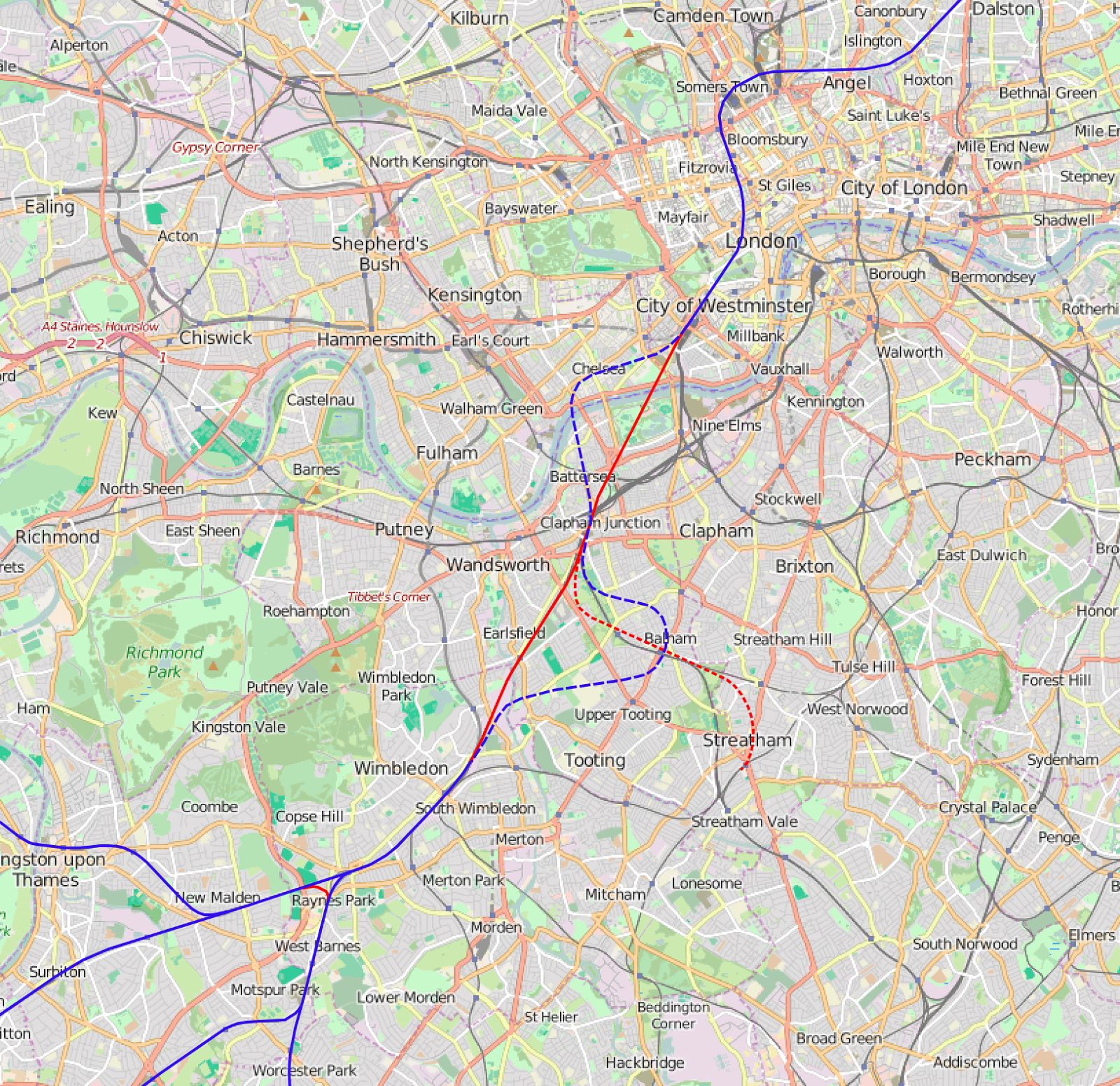
This map outlines the current TfL plan for Crossrail 2 between Clapham Junction and Wimbledon, via Balham.

As can be seen, the "Balham Bulge" route from Wimbledon to Clapham Junction via Balham is very indirect. In addition, the chosen tunnel portal site to the north east of Wimbledon, requires the demolition of most of Wimbledon town centre, including the Centre Court shopping centre (everything along the purple line on the map is demolished). The Swirl plan removes the ineffective Balham Bulge and avoids the need to demolish Wimbledon town centre.

For more details on why a Balham routing will not be effective, see the previous article on how TfL's plans make the Northern Line overcrowding worse not better.

Crossrail 2 Swirl

Crossrail 2 Swirl is a proposal to alter the route and design of Crossrail 2 between Clapham Junction and Wimbledon. Instead of serving Balham or Tooting, Swirl serves Earlsfield, hence the name - "SW EARLsfield".

To provide the total capacity increase needed for South West London, Surrey and Hampshire, a total six tracks are needed from at least New Malden to Clapham Junction. To provide this, Swirl proposes a tunnel from the A3 between New Malden and Raynes Park all the way to Clapham Junction and beyond, giving four tracks on the surface and two tracks in tunnel. Between the junction at New Malden and the A3 tunnel portal, six tracks would be provided by removing the fast line platforms at New Malden.

The A3 tunnel portal site has a key advantage over TfL's Gap Road site in that it has excellent road access. Being able to send heavy vehicles down the A3 to the M25 will have major benefits for local roads.

All fast line services from Surrey, Hampshire and beyond would run via the new tunnel under New Malden, Raynes Park and Wimbledon. No underground stations are needed on this section as these are the fast lines. The existing four tracks through Raynes Park on the surface would be used for Crossrail 2 and outer suburban services to Waterloo.

At Wimbledon, the existing six platforms would be retained. A new footbridge would be needed to cope with increased usage, but the rest of the town centre would be completely unaffected. Crossrail 2 trains would use the existing slow line platforms. The outer suburban services to Waterloo would use the existing fast line platforms, providing a cross-platform interchange. This will allow passengers to change to a high frequency Waterloo service (TfL proposes an interchange to a much lower frequency Waterloo service).

In order to provide a high frequency service through the core of Crossrail 2, it is necessary to turn back some trains at Wimbledon. This would be achieved using the existing Thameslink platforms, with the tram evicted to run at street level. Thameslink services would share the platforms.

The key part of the Swirl proposal is the very large Weir Road industrial site between Wimbledon and Earlsfield. This would be used to "swap" usage of the tunnel. The fast tracks would be taken out of the tunnel and back to the surface to use the existing surface tracks to Clapham Junction. The same site would also be used to take the Crossrail 2 tracks down into the tunnel. As a result, Earlsfield station would be replaced with a sub-surface station.

Note that the proposal is for a single tunnel all the way from New Malden to beyond Clapham Junction using a single Tunnel Boring Machine (TBM). While this may seem strange, the costs associated with tunnelling tend to be at the tunnel portals, with the distance that the tunnel is driven being a secondary consideration. As such, it is cheaper to have a single TBM rather than two separate tunnels. The "swap" at Weir Road involves a relatively simple cut and cover box that would be built after the TBM had passed through the site.

The Crossrail 2 Swirl proposal has minimal impact on the branches that can be served by Crossrail 2 in outer London. As such, the map of services below shows the same branches as TfL's official scheme:

However, unlike the TfL scheme, none of the outer suburban (green) services need to stop at Earlsfield or Raynes Park, providing a faster journey for many passengers. It should be noted that only those outer suburban services to Twickenham would stop at new Malden.

Benefits

The Swirl proposal has the following benefits compared to the TfL plan:

  • £1.5bn cheaper (estimated)
  • Much better service for Earlsfield
  • Better services to Surrey, Hampshire and beyond
  • No need to demolish the entire centre of Wimbledon
  • Tunnel portal with direct access to the A3 for lorry traffic
  • Does not worsen the overcrowding on the Northern Line

The cost estimate is very rough, but there is no doubt that Swirl has a lower cost than TfL's plan. The total length of tunnel from New Malden to Clapham Junction is just 1km longer than the indirect tunnel from Wimbledon to Clapham Junction via Balham. This has an extra cost of about £100m. The sub-surface station at Earlsfield should be cheaper to build than the tunnelled station proposed for Balham, saving perhaps £100m. The tunnel "swap" is again a relatively simple construction, perhaps £200m. The primary difference is therefore is the large amount of work avoided at Wimbledon.

At Wimbledon, TfL is currently planning on demolishing the entire town centre. The main covered shopping mall, Centre Court, and many more buildings would be demolished to allow an additional four platforms to be built along with a long cut and cover box. The disruption caused will be immense. It is very hard to estimate the cost of this work, however £2bn does not seem like an unreasonable estimate. By contrast, Swirl requires minor changes to the existing station, plus some new tram tracks, for a far lower cost.

The Swirl plan provides better services to outer suburban services such as Surbiton, Claygate, Walton and Guildford. This comes from the ability to provide more services now that the outer suburban trains do not need to serve Earlsfield. These services will also save time without the need to stop at Earlsfield.

Swirl provides a better service to long distance services from places such as Portsmouth, Basingstoke, Winchester and Southampton. The benefit here is that the fast services will run via the new tunnel between New Malden and Earlsfield. The new tunnel will have a higher speed limit than the existing fast tracks on the surface. As such there would be a small journey time saving (which cost-benefit calculations tend to place a high benefit value on).

At Earlsfield, the new sub-surface station can be constructed south of the existing station and double ended (two exits, one at each end). This would provide an exit from the station to the far end of the Weir Road site. Assuming that the Weir Road site is still used for a train depot, there is no reason why the depot cannot be covered with a concrete deck. This allows the site to be used for massive development, with enhanced value thanks to the new station entrance/exit.

Additional notes

Update 2015-11-29: This section was added to provide some additional notes on Swirl primarily for TfL and Network Rail.

Swirl proposes the "tunnel swap" occurs at the Weir Road site. This is because it is known that the site is large enough at 1km long. However, there would be cost benefits to perform the swap north of Earlsfield alongside the cemetery. This is a much narrower site however. If the prison becomes available for redevelopment, it may be possible to use that site to make this alternate swap location more practical.

Swirl proposes the tunnel portal next to the A3 at New Malden. This is good for road access, but not the easiest in construction terms. The next possible portal site is north-east of Berrylands station, on the east side of the river north of some housing. That site has less good road access, but is completely off the railway, potentially making it easier to construct. A proper engineering analysis would be needed to compare the two sites.

Swirl has two elements - a fast line tunnel under Wimbledon and serving Earlsfield instead of Balham. It should be noted that the fast line tunnel part of Swirl is compatible with serving Balham, although the author does not believe that to be the best approach.

Relieving the Northern Line

Update 2015-12-10: Since serving the Northern Line is critical to Crossrail 2, the Swirl plan has been extended into the Swirl-Max plan, which serves Earlsfield, Balham, Tooting and Streatham. Swirl-Max is the version to be submitted to the TfL consultation.

Originally, this article proposed that the Northern Line could be relieved by extending the Northern Line Extension (West End branch) from Battersea Power station to Cedars Road on the Clapham/Battersea border and on to Clapham South and/or Balham. This option has now been dropped as further analysis showed it would not work.

Summary

Crossrail 2 Swirl is a detailed plan to provide a better solution for South West London, Surrey and Hampshire. It proposes a single tunnel from New Malden to Clapham Junction and beyond, with a tunnel "swap" between Wimbledon and Earlsfield. This avoids the need to destroy Wimbledon town centre, and saves around £1.5bn in the process. See the Swirl-Max plan for how Balham and Tooting would be served.

The October 2015 consultation is now closed, but readers are encouraged to continue to speak to politicians and others in power to fight for a better option for Crossrail 2. Use the term "Fast Line Tunnel" or "Crossrail 2 Swirl".

Sunday, 8 November 2015

Crossrail 2 and the Northern Line

TfL's plans for Crossrail 2 have always included a connection to the Northern line between Clapham Junction and Wimbledon. This blog has long argued that this is a mistake. Here is the detailed explanation as to why.

Update 9 Feb 2016 - The final article in the series, Crossrail 2 Swirl-Max - is now published.

Update 12 Nov 2015 - The next article in the series, Crossrail 2 Swirl - is now published.

Update 15 Nov 2015 - A full analysis of journey times is now complete:
Journey times with CR2 station at Balham (the TfL plan)
Journey times with CR2 station at Tooting Broadway
Journey times with CR2 station at Earlsfield (the Swirl plan)
Journey times with CR2 station at Earlsfield and branch to Balham/Streatham/Tooting (the Swirl-Max plan)

Crossrail 2 and the Northern Line

Until October 2015, the TfL plan was to take Crossrail 2 between Clapham Junction and Wimbledon via Tooting Broadway to link with the Northern line. In the October 2015 consultation, Balham is proposed instead of Tooting Broadway:

The stated purpose of the Northern Line connection on Crossrail 2 is:

A Crossrail 2 station at Balham would still provide very similar benefits to one at Tooting Broadway, principally helping relieve crowding on the most congested parts of the Northern line.

As can be seen, the pressure is to provide additional capacity for the Northern Line. Already today, it is very difficult to get on a northbound Northern Line train at any of the three Clapham stations in the morning peak. The Crossrail 2 station is supposed to help alleviate this.

Unfortunately, Crossrail 2 could well make the Northern Line crush worse not better.

The Capacity Difference

Each Crossrail 2 train will have a capacity of around 1500 people (10 car trains of mainline size). Each Northern Line train has a capacity of around 665 people (6 car trains of tube size). Thus, each Crossrail 2 train will have around 2.25 times the capacity of each Northern Line train.

Both services, Crossrail 2 and the Northern Line will run at around 30tph (trains per hour). Thus, the capacity difference between the two lines is fixed around 2.25.

If 1 in 6 people on a Northern Line train transfer to Crossrail 2 then that is about 110 people. But if 1 in 6 people on Crossrail 2 transfer to the Northern Line, that is around 250 people. As should be immediately obvious, relief of the Northern Line only happens if more people transfer from Northern to Crossrail 2 than the other way around.

Put another way, a transfer of 1 in 6 people from the Northern Line train to Crossrail 2 is equivalent to a transfer of 1 in 15 people from Crossrail 2 to the Northern Line. But who will transfer and why?

The Journey Time problem

To determine who will transfer, it is necessary to look at the journey times.

From Balham to Moorgate is 23 minutes by Northern Line. The same journey using Crossrail (taking Crossrail 2 to Tottenham Court Road and changing to Crossrail 1) would take roughly 22 minutes (13 minutes to Tottenham Court Road, 4 minutes to change and 5 minutes to reach Moorgate). Thus, Crossrail offers a very small 1 minute saving and the risk involved in a change of trains.

From Balham to Bank station is 21 minutes by Northern Line. By Crossrail it would be 28 minutes changing at Victoria to the District Line or Angel to the Northern Line, which is 7 minutes longer.

Travelling to London Bridge? 19 minutes by Northern Line, or 30 minutes by Crossrail changing at Angel to the Northern Line (Crossrail 2 has no access to the Jubilee Line). That is 11 minutes longer by Crossrail.

And Canary Wharf? It is around 30 minutes on the Northern and Jubilee Lines, and around 31 minutes on Crossrail (Crossrail to Canary Wharf is a low frequency service at 12tph).

For completeness, Crossrail 2 will of course save large amounts of time for journeys to the West End near Victoria, Leicester Square and Euston.

Putting the pieces together

Given these two key points - relative capacity and journey times - the real question is whether routing Crossrail 2 via Balham (or Tooting) makes sense. People generally take the quickest route.

To summarize, these are what I calculate to be the quickest routes:

  • Any station from Morden to Tooting going to London Bridge, Bank or Moorgate - stay on Northern Line
  • Any station from Morden to Tooting going to Canary Wharf - Northern Line then Jubilee Line
  • Any station on Crossrail 2 via Wimbledon going to London Bridge or Bank - change from Crossrail 2 to Northern Line
  • Any station on Crossrail 2 via Wimbledon going to Moorgate or Canary Wharf - stay on Crossrail 2 and change to Crossrail 1

Thus there are two conclusions:

1) No one already on a Northern Line train approaching Balham and heading to London Bridge, the City or Canary Wharf will change onto Crossrail 2.

2) Anyone on a Crossrail 2 train from Wimbledon and heading to London Bridge, or the south part of the City will change onto the Northern Line.

Given these conclusions, TfL's claims that Crossrail 2 will relieve the Northern Line look very very duboius. Just think about the sheer number of jobs in the City and Canary Wharf if you have any doubts.

And as a final kicker, routing Crossrail 2 via Balham (or Tooting) is considerably more expensive than routing it via Earlsfield. A topic that will be the subject of my next article!

Summary

Each Northern Line train is a lot smaller than each Crossrail train, so relief of the Northern Line depends on few people transferring from Crossrail 2 to the Northern Line. Unfortunately, journeys to key destinations such as London Bridge and the south part of the City are quicker by changing from Crossrail 2 to the Northern Line.

As such, this analysis suggests that routing Crossrail 2 via Balham or Tooting is highly unlikely to reduce crowding on the Northern Line by much and may well make it worse.