Showing posts with label crossrailssw. Show all posts

Sunday, 24 March 2013

Mole Valley Link

In my last blog I outlined Crossrail SSW, a plan that gains 50% extra train paths on the SWML (South West Main Line) into London Waterloo, fully separating the long-distance, outer suburban and inner suburban services. This blog extends that proposal, making use of the extra capacity to enhance services in the Mole Valley.

Mole Valley Link

The Mole Valley towns of Leatherhead and Dorking do not get an especially good train service. The fastest train from Dorking takes 50 minutes, with neither the route to Waterloo nor the route to Victoria being especially fast. This proposal allows for a faster service, with other knock-on benefits.

The proposal involves constructing a new railway line across open countryside from north of Leatherhead to south of Claygate. The route crosses the M25, A243 and A3, as well as the Prince's Coverts forest. The length of the link is 5.5km.

Here is a map of the new link being proposed (click for Google Maps). New link in red, existing lines in black:

Mole Valley Link map

At first glance, the link can seem like a strange choice. The shortest "missing link" in the area is Leatherhead to Chessington South, a link which was planned to be constructed in the past. However, the Chessington link would not have the same benefits as this proposal.

The key point to note from the Crossrail SSW proposal is that the inner suburban service pattern is fully accounted for with Epsom, Chessington, Hampton Court and Kingston (the SWML slow lines). The long-distance service pattern is also fully accounted for (in the new express tunnel from Esher). However, there is still available tph capacity on the outer suburban pair of tracks (the SWML fast lines from Surbiton to Waterloo) as services to Woking and Claygate would not fill the available paths.

Given the available spare paths, clearly the purpose of this proposal is to use some of them, say 4tph (trains per hour) to enhance the Dorking service. But this is only possible if the Dorking trains can reach the fast lines of the SWML before Surbiton. If the link were to go via Chessington, then the additional services would hit Raynes Park on the SWML slow lines, which would defeat the objective of enhancing the Dorking service (and detract from Crossrail 2 generally). By linking Leatherhead to Claygate, the fast Dorking services are able to join the SWML fast lines, exactly as the Guildford via Claygate services would.

In total, the route from Leatherhead to Waterloo is about 1.5km longer via Claygate than via Epsom. But the faster line and fewer station stops would more than compensate. The expected service pattern would be 2tph Dorking, Leatherhead, Surbiton, Wimbledon, Clapham Junction, Waterloo. A journey time of 40 minutes from Dorking should be easily achievable, with 35 minutes being a better target.

In cost terms, building in open countryside should be relatively cheap, however there are crossings of major roads to manage. An initial estimate of £250m seems appropriate (based on the Hitchin flyover at £50m).

Improving the lives of the residents of Dorking and Leatherhead is not, in and of itself, going to be sufficient to justify the link. There are two other factors that should be considered.

Firstly, the link provides much better access from mid-Surrey to the county town of Kingston (accessed via Surbiton). Providing the local links from Surbiton to Kingston town centre are top notch, this could encourage a reduction in the traffic making that journey, especially to shop.

Secondly, and more significantly, the new link can be used to change services from Horsham.

The Horsham connection

The route from Horsham to London (Victoria) via Dorking was the traditional route for services from the Arun valley line (Billingshurst, Arundel, Bognor Regis, Chichester). Over time however, the route became less well used by fast services, with a desire to boost services to Gatwick airport and East Croydon.

Unfortunately, over time, the route via East Croydon has become very full, to the extent that major work will be needed to avoid or enhance East Croydon. Such a project would undoubtably be multi-billion pound. The great thing is that this proposal can step in to be a cheap approach to delay the need for that work.

With the Mole Valley link open, this proposal intends for fast services from Horsham and the Arun Valley to run via Dorking and Surbiton to Waterloo instead of via Gatwick and East Croydon. This would be at least 2tph, and probably 4tph, of additional running between Horsham and Dorking. Horsham would still have services to Gatwick and East Croydon, but they would be slower ones via Redhill (probably Thameslink). There would probably be no direct service from the Arun Valley to Gatwick, at least in the peak.

While Horsham has a long standing link to London Victoria, Waterloo is similarly located for Whitehall jobs and the West End, and cross platform interchange for Victoria at Wimbledon in Crossrail SSW provides for the rest. With this plan, it is intended that there would be no direct fast services from Horsham to Victoria.

The key to this move is that it frees up at least 2tph through East Croydon. Those two paths would be enough to reduce the pressures on the need for a multi-billion pound rebuild there. As such, the £250m of the Mole Valley Link is a real bargain, even allowing another few million to improve the Horsham to Dorking route's line speeds.

Summary

The Mole Valley Link is a 5.5km new railway line from north of Leatherhead to south of Claygate. It allows the Dorking services to join the SWML fast lines at Surbiton, avoiding the slow lines at Raynes Park. By enhancing journey times to Dorking it allows the fast services from the Arun Valley and Horsham to run via Dorking and Surbiton into Waterloo, instead of Victoria.

Benefits are threefold - enhancing journey times to Dorking and Leatherhead (a 10 to 15 minutes saving), better links for mid-Surrey to Kingston, and reducing pressure on East Croydon through the re-routing of the Horsham services.

If you have any views on the Mole Valley Link then why not leave a comment!

Wednesday, 13 February 2013

Crossrail SSW - A better, cheaper Crossrail 2

TfL, London First and Network Rail are starting to put together plans for Crossrail 2. This blog looks at the plans for South West London and an alternative, cheaper, plan - Crossrail SSW.

Update 2015-11-30: This scheme has now been superceded by Crossrail 2 Swirl, which takes the same idea as outlined here and updates it to 2015. Most of the analysis below remains valid, as does the connected Mole Valley Link proposal.

Published proposals

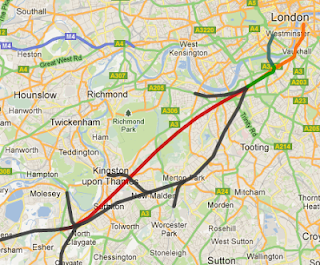
The base set of proposals to compare against come from London First (it appears that TfL are taking the lead behind the scenes). In Central London, the route runs from Euston/St.Pancras/Kings Cross (HS2 and other routes to the North) to Tottenham Court Road (Crossrail 1) to Victoria. This section is relatively uncontroversial.

In South West London, the Crossrail 2 (CR2) plan routes from Victoria to a new stop in Chelsea, then Clapham Junction, Tooting Broadway (Northern line), Wimbledon before surfacing from tunnel. It then takes over services to Epsom, Chessington, Shepperton, Twickenham and Hampton Court.

London First Crossrail 2

The key question is whether this route works for Soth West London? Sadly, there isn't any real detail behind the route maps, so there are more questions than answers.

The biggest question is how will Earlsfield be served? Earlsfield is the station between Wimbledon and Clapham Junction on the South West Main Line (SWML), and is served by the services the plans absorb into CR2. But if those services aren't stopping there, what will? The services remaining on the SWML will be longer distance ones, to Portsmouth and Southampton, and mid-distance ones, semi-fast to Woking and Guildford via Claygate. The semi-fasts currently stop at Earlsfield, but their 4tph (trains per hour) service would be insufficient for Earlsfield's needs (any less than 12tph would not work).

The next biggest question is how many additional fast paths are added? This is important, because the real problem on the SWML is in long-distance services, not the short-distance ones planned to be absorbed by CR2. Network Rail state that the short-distance services could be extended from 8-car trains to 12-car trains and run more frequently to handle overcrowding. By contrast, the long-distance services are already at the maximum number of trains per hour and train length, leaving no options for growth.

The CR2 plans appear to suggest a fifth track between New Malden and Wimbledon, allowing an additional 9tph, or an extra 19% capacity. But this is of dubious value. Squeezing in an additional track (or more sensibly two tracks) is a major task for a working railway, and anyway some of the additional fast trains are going to have to stop at Earlsfield. In addition, it still means that the SWML is operating at absolute maximum capacity with no space for recovery, resulting in unreliable journeys and a general lack of resilience.

Crossrail SSW (Surrey and South West London)

This is a proposal to rearrange the proposals in South West London, providing more capacity for long-distance services, where it is needed and more effective use of existing assets, and all for a lower total cost.

The key task is to address the three distinct flows on the SWML. These are:

  • Inner suburban - services to Epsom, Leatherhead, Dorking, Chessington, Kingston, Shepperton, Twickenham, Hampton Court and slow services to Woking
  • Outer suburban - services to Guildford via Claygate and Woking semi-fast, but conceptually including services to Farnham and Guildford via Woking
  • Long-distance - services to Portsmouth, Basingstoke, Winchester, Southampton, Bournemouth, Weymouth, Salisbury and Exeter

Currently, there are 2 tracks for the inner suburban services and 2 tracks shared between the outer and long-distance services. It is this sharing that causes many of the delays and problems on the SWML.

To separate these three distinct flows, the SSW plan has two distinct parts:

The first part is a new express tunnel from Esher to just east of Clapham Junction. This tunnel would have no stations and be for the use of the long-distance services. As a new, dedicated 2 track tunnel, it would be built to modern standards and be capable of having trains running at 100mph or more, unlike the current SWML which is restricted to 75mph on the fast tracks through London. As such, journey times would be slightly shorter for the long-distance services, perhaps 5 minutes shorter for long-distance services.

The second part is a core London tunnel, similar to CR2, starting from the Clapham Junction area. Since all the long-distance services have been removed from the SWML from Surbiton inwards, the existing 4 tracks between Clapham and Surbiton can be used without conflicts. The outer suburban trains would run on the old SWML fast lines, with the inner suburban services remaining on the slow lines as now.

One key problem any Crossrail 2 type proposal faces is that it will change existing commutes, something which frequently causes a backlash. There are no signs that the official proposal is addressing this. The SSW proposal has a ready-made solution for this. The inner suburban services on the slow lines and the outer suburban services on the fast lines would both stop at Wimbledon, where it is a cross-platform change. Thus, Epsom to Waterloo would still be possible via an easy cross-platform change at Wimbledon. Similarly, Claygate to Victoria would be possible using the same cross-platform change, in the opposite direction.

The tunnel portal for the core London section is the other crucial element in the SSW plan. The Clapham Junction area has vast amounts of railway land and existing tracks. One of these runs from Clapham Junction station down to Longhedge junctions and the site of the new Battersea Northern line extension station. A new interchange station would be built there, providing access to the vast new Nine Elms development, and a secondary route into Waterloo via Northern line (resilience).

Here is a map of the two parts:

Surrey and South West London Solution map

And here is how the services would be separated:

Surrey and South West London Solution map

The CR2 inner suburban routes are in black, the outer suburban routes are in green, and the long-distance in red, going through the new tunnel. In order to balance the frequencies, the Shepperton service is allocated to be outer suburban, swapping between the fast and slow lines at New Malden. This gives Kingston services to both Waterloo and Victoria. The CR2 services to Dorking and Effingham Junction are unfortunate (Epsom or Leatherhead would be a better terminus), but cannot be avoided without an additional project (not discussed here).

The proposed SSW inner suburban 24tph service is as follows:

  • 8tph to Epsom, some continuing to Dorking or Guildford via Effingham Junction
  • 4tph to Chessington South
  • 8tph to Twickenham
  • 4tph to Hampton Court

The proposed SSW outer suburban service is as follows:

  • 4tph to Shepperton via Kingston (total of 12tph London to Kingston)
  • 4tph to Guildford via Claygate
  • 4tph to Guildford via Woking (all stations Surbiton to Guildford)
  • 2tph to Farnham, non-stop or one-stop Surbiton to Woking, then all stops
  • 2tph to Basingstoke, non-stop or one-stop Surbiton to Woking, then all stops
  • up to 8tph additional paths not modelled here

The long-distance services are not explicitly modelled here, however they would cover all existing services that run fast from Waterloo to Woking or beyond. Given that the current timetable is very constrained by lack of available paths, the long-distance services would likely be completely reworked, with up to 24tph available.

The scheme has a number of benefits:

  • 50% more tracks into London than the current SWML allowing 50% more trains, 72tph instead of 48tph
  • Existing commuting patterns are respected, with easy cross-platform change at Wimbledon
  • Much greater resilience if there is a problem, with two virtually independent fast lines, one in tunnel and the existing one above ground
  • Easier access for maintenance, late evening services could use either the tunnel or the old fast line, allowing the other to be maintained from 10pm onwards

And as mentioned as the beginning, the SSW proposal is cheaper than the TfL/London First proposal. They can be compared by examining figures south of Victoria:

ItemTfL planNotes
Tunnelling£1,200m12km (Wimbledon-Victoria) at £100m/km
Wimbledon station£300mDeep tunnelled, links to existing station
Tooting station£300mDeep tunnelled, links to existing station
Clapham Junction station£500mDeep tunnelled, complex links to existing station
Chelsea station£300mDeep tunnelled, expensive part of London
Fifth track£1,000mFifth track in Network Rail RUS ("over £1bn")
TOTAL£3,600m 

Meanwhile the SSW plan has these costs:

ItemSSW planNotes
Tunnelling£1,800m16km (Esher-Clapham) and 2km (Battersea-Victoria)
Battersea station£200mSub-surface reduces costs
Remodel Clapham-Battersea£200mRailway land, relatively simple changes
TOTAL£2,200m 

Thus, the SSW plan is of the order of £1.4bn cheaper than the TfL plan. (As a general rule, tunnelling is cheap, but underground stations are expensive)

The main downside of SSW against TfL is that it does not serve Tooting Broadway, and thus has a far smaller effect on the Northern line. In effect, the SSW proposal reduces benefits to those along the Northern line, and increases benefits to everyone along the SWML beyond Surbiton, as far as Portsmouth, Southampton, Bournemouth and Exeter. This seems like a good trade off, especially given the lower cost. However, given TfL's focus on London, they are unlikely to agree with the trade off.

Summary

The Tfl plan for Crossrail 2 in South West London still lacks details and is thus hard to criticise in depth. However, the intended route is known and the ability of that route to relief the long-distance services (where the real capacity crunch is) can definitely be questioned.

The Crossrail SSW (Surrey and South West London) proposal combines two parts, an express tunnel and a shorter Crossrail 2 tunnel, to produce a scheme that provides far more available train paths at lower cost.

If you have any views on the two proposals - TfL vs SSW - then why not leave a comment!


Update 2013-03-24: The Mole Valley Link is a related proposal that makes full use of the extra capacity of Crossrail SSW to enhance Dorking services and relieve East Croydon.